
Post 2 of 7 in a series for UK agency finance leaders facing their first year-end under the amended FRS 102.
Most agencies already net off media. The FRS 102 risk is on anything else you still bill gross.
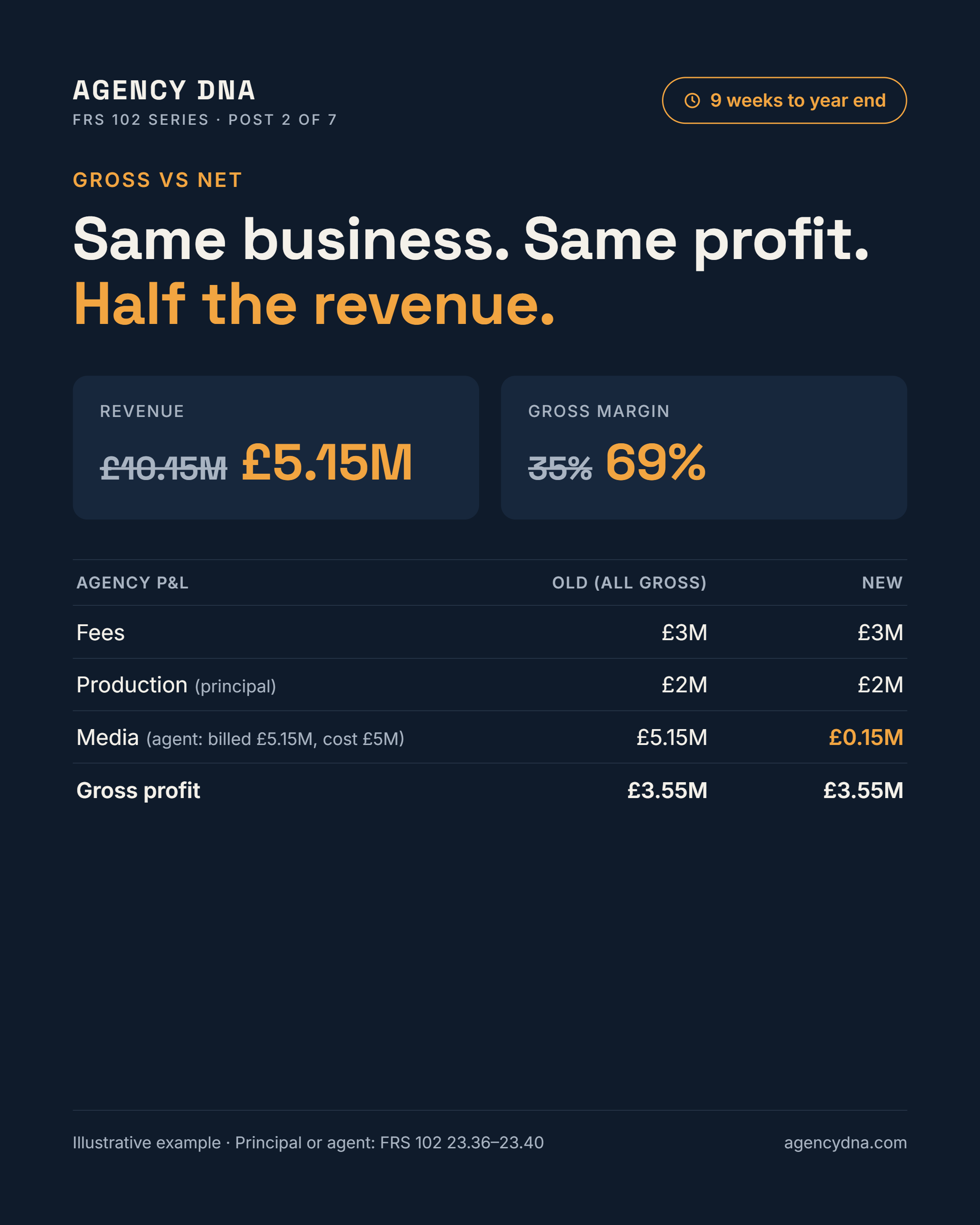
An agency billing £10M, half of it media, could end up reporting around £5M of revenue at the same profit.
1. The principle isn’t new, the test is
Agencies have long reported fee and commission income.
What changes is how you decide. Under pre-2026 FRS 102, you were principal if you had exposure to the significant risks and rewards of the sale. The indicators were primary responsibility, inventory risk, latitude in setting prices and bearing the customer’s credit risk.
The amended Section 23 now asks a different question: do you control the specified good or service before it passes to your client? (FRS 102 23.36–23.40)
You now need to assess each promise separately, not the contract as a whole (23.36).
Paragraph 23.38 gives three indicators that you are principal: primary responsibility for fulfilment, inventory risk, and discretion in setting the price. Carrying the bad-debt risk is no longer one of them.
2. The one-question test
Do you control the service before it passes to your client? (23.36–23.40)
In practice, that comes down to two questions: Do you direct the supplier and build their work into your own deliverable at an agreed price? Or, do you arrange the supplier at the client’s direction? The first makes you the principal, the second makes you the agent.
Most FDs already know this. The standard now spells it out: 23.37(b) covers directing the supplier, and 23.37(c) covers combining their work into your deliverable.
What’s new, though, is that you now have to evidence it, promise by promise, and this is what your auditors will likely be asking.
3. Where agencies typically land
Default positions are no longer good enough. It will be the terms that decide.
Media buying: agent, unless you buy inventory on your own account and resell it (principal-based trading).
Production you direct and carry the risk on: usually principal.
Freelancers working inside your team: principal.
Talent and usage rights: depends on who contracts and who carries the risk.
Travel and out-of-pocket recharges: usually principal, because you use them to deliver your own service.
Tech licences and AI platforms bought for a client: you’ll need a test for each one.
4. Why it matters beyond the top line
Profit and cash don’t change, but plenty of other things can be affected:
KPIs: gross margin % could double, which may break KPI trends and benchmarks.
Company size tests: turnover is one of the size criteria (now £15M for small and £54M for medium; you need to meet two of the three criteria, two years running). A move to net may change audit exemption or company size. An agency billing £20M with £8M of media could fall below the small-company turnover limit.
Contracts and deals: bank covenants, earn-outs and valuations based on revenue multiples.
Bonus schemes linked to revenue.
5. What to do before December
List your pass-through cost categories, eg production, freelancers, talent and usage, travel, tech licences etc.
Test one real contract per category against the question above.
Start reporting billings, revenue and net revenue side by side, so your board can see the bridge rather than a sudden drop.
Choose your transition route now (1.61). Under the cumulative-effect route, comparatives aren’t restated (1.62(a)), so 2025 gross and 2026 net can sit side by side in the same accounts. In the first year you disclose the adjustment to revenue and to profit or loss, with reasons for any significant changes (1.63).
What’s the biggest pass-through line in your P&L, and has anyone tested it against the new rules?
Here’s a simple worked example
Same agency, same gross profit: revenue halves and gross margin roughly doubles.
The fine print
Mixed contracts: one job can hold both principal and agent elements; each promise will now be assessed separately.
Timing of media commission: where commission on media placements still operates, it is recognised when the performance obligation is satisfied: when the media is broadcast, published or served, and verified.
Rebates and credits you give clients (eg a volume rebate on fees) reduce revenue, not costs (23.63). Media-owner rebates you’re contracted to pass back are different: as agent, they were never your revenue.
Disclosure: a revenue split by principal and agent is a natural fit for the disaggregation note.
What is the disaggregation note?
FRS 102 23.131 requires you to split revenue into categories that “depict how its revenue and cash flows are affected by economic factors”. The standard’s examples include type of service, geographical market, type of customer, timing (point in time vs over time) and, at 23.131(e), “revenue earned as an agent or as a principal”. For an agency, the natural split is revenue type (retainers, projects, production, media commission) by timing by principal/agent. That last split is where gross vs net becomes visible to anyone reading your accounts.
Who has to give it?
Medium and large companies give it. Small companies under Section 1A are exempt (1AC.32B only requires 23.135(a)–(c)), and so are qualifying entities using the reduced disclosure framework (1.12(cB)), which covers many network-owned agencies. The Companies Act requirement to give particulars of turnover (SI 2008/410, Schedule 1 paragraph 68) still applies, and the 23.131 analysis may not be enough on its own to meet it (A3.38A).
Can you keep your margins private?
Company law lets directors withhold the turnover analysis by business class and market if disclosure would be seriously prejudicial, provided the accounts say so (SI 2008/410, Schedule 1 paragraph 68(5)). FRS 102 has no equivalent exemption for the revenue disaggregation note. You choose the categories, but the standard names “revenue earned as an agent or as a principal” (23.131(e)), and for most agencies that’s exactly the split that matters. If it’s missing, expect your auditor to ask why.
Next week: retainers, milestones and bonuses under the five-step model.
Sources:
